
This is an excerpt from my book, Queering Contemplation: Finding Queerness in the Roots and Future of Contemplative Spirituality, you can order the book here.
True attention, in its rarity and freeness, is queer. Attention is the undistracted self, willing to truly look, deeply understand, and release attachment to moments before or after what is present. Attention is not concerned with naming, capturing, or solving— because attention’s primary concern is presence, love, and being. For the contemplative, attention is an inner posture of presence. This posture is not militant or demanding, but is a force of simultaneous effort and surrender.
Paying attention to the Divine within and around us is at the heart of the curiosity that inhabits contemplation. In a world of distraction, it has become a queer kind of thing to pay attention to that sacred presence. When everything around us seems precarious, queer contemplative attention is the disarming nature of witnessing life at the pace of stillness—a pace contradictory to societal expectations. And when that stillness merges with the truth of presence, we are brought to the place of seeing the is-ness and enough-ness of everything here, because it’s exactly where we are, much like the invitation of boredom.
I think about a conversation with my therapist, who prods me with difficult questions (shout-out to all the good therapists out there). “How would you describe that part of yourself that you want to come out more often?” they ask.
Without hesitation, I say, “Playful, alive, and shy.”
“And what would it look like for this ‘playful, alive, and shy’ self to emerge more?” the therapist digs deeper. Before I reply, they add, “Knowing internally that you have the boundaries necessary when you sense it going too far.”
Now I meet my hesitation. Exactly, I think to myself, even in the way I pause to control my answer so tightly, keeping all these thoughts inside. Why am I so afraid of that part of myself ? The part who longs to be freer and more attentive to the expanse of the present moment. The part of myself who could truly pay attention by pushing away the desire to control, understand, grasp, clench, or even seek comfort in any given situation. The part of myself who is enough in this very moment. The part of me who is.
Then, like clockwork, the reel of old stories rolls through my head, delaying my response further. And yet I know that the old stories no longer serve me. When I was only eight, my parents were called in to my school by my second-grade teacher because I was “worrying too much.” At that time, few used the word anxiety to describe what began for me when I was very young. What’s more, my anxiety was compounded because I didn’t yet know how to metabolize feelings—my own or those of others that I took on. Instead, I carried the weight of those unspoken emotions with me, often creating a stifled self, unable to pay attention to my internal world, clouded by the emotions of others, too overwhelmed to be in the present moment.
I became the family worrier. Carrying the impossible, I thought I could make everyone around me feel better. I worried so much, as an attempt to help or control, that I hoarded the unspoken feelings and pains around me as if they were my constant responsibility to fix, help, or heal. Every nook and cranny of my life was so consumed by someone else’s energy that I left very little room for knowing, understanding, or expressing my own.
Purging, releasing, letting go of this sense of control, developing my own boundaries—cleaning up my internal home— continues to be a long process. I’ve had to relearn what it really means to pay attention, to get vulnerable and feel feelings, to have a say about what is invited into and what belongs in this house called my body. After all, how can we pay attention and offer presence to the world if we aren’t paying attention and offering presence to ourselves?
A part of my own healing process has been paying close attention to those old stories, the ways they’ve created stifled feelings and shadows to understand and transcend. This inner work of paying attention hasn’t been as simple as going through a box of old items, of course. It is much more like a slow and painful ripping off of parts of myself that no longer work, are no longer true, or are causing me or those in my life harm. And these pieces must be paid attention to—they must be seen, held, understood, and released—for me to truly engage with the new story, the gift of the old story, and the healing required for the next healthy step forward. Some of those feelings, through therapy and attention to my inner work, can then come up and out through my voice. Other feelings I return to their rightful owner, or I simply release and discard them, as they are not mine to carry. And many of them—rotten and tethered to false narratives about myself, others, or my life—I simply toss in the trash. They are neither mine to carry nor mine to give or project upon anyone. In those moments, queerly and uncomfortably, vulnerably and softly, I recognize that the gift of attention is a vital part of love.
As I lean into this inner work of paying attention, I come closer to that wild, playful, shy, and alive self—those parts of my healing and wholeness necessary for progress. In these moments, I find myself attending with abandon—sinking my mind, my teeth, and my toes into the present moment without hesitation. There is no longer a need to hold, do, fix, accomplish, create, or produce. I can only offer the fullness of attention to myself and others in its most clarified form. My mind and body are more cleansed of the clutter that never belonged to me anyway. And like most things related to growth and healing, this requires me to practice attention patiently, over and over and over again.
To pay attention, truly and queerly, hasn’t just suddenly become my natural mode of operation. It takes conscious effort, vulnerability, and discomfort to release myself from the bonds of old stories, to strip away my old patterns, and to let go into the truth of the present moment. Paying attention requires practice. Zenju Earthlyn Manuel said it this way in an interview on the Contemplating Now podcast: “Practicing to be a contemplative, you are . . . learning to be embodied and to be boundless at the same time.”
My most alive, playful, and shy self is also my most queer self. Continually being oneself, after all, requires a presence and attention to self, and an acceptance of the lifelong process of evolving, growing, and emerging. Tending honestly to the deepest parts of ourselves and letting go of the harmful stories and expectation of others is one way we can queerly pay attention.
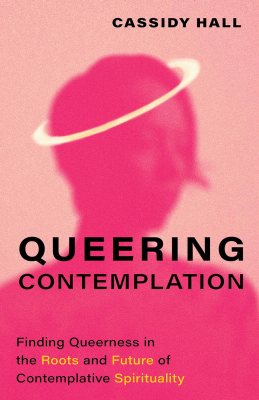
This is an excerpt from my book, Queering Contemplation: Finding Queerness in the Roots and Future of Contemplative Spirituality, you can order the book here.

 Dr. Cassidy Hall, DMin, MDiv, MTS, MA
Leave a comment