
In the summer of 2011, I visited my brother, sister-in-law, and nephews in Los Angeles when they told me about an exercise class in Beverly Hills led by Richard Simmons.
Richard Simmons, I thought, the one whose Sweatin’ To The Oldies VHS tapes I watched as a child?
Yep, that’s the one.
Simmons had taught classes and hosted inspirational seminars at his studio, Slimmons, in Beverly Hills since 1973. Now, in his 40th year of teaching, there was no indication of him slowing down. A 75-minute class for 12 dollars with the iconic Richard Simmons? I was in.
Despite not being a hot yoga class, the room must have been 80 degrees and filled with dozens of warm bodies. I arrived in my sweatpants and sweatshirt, layered in a lifetime of experience of covering my body.
Before we began, Richard entered and greeted everyone equally, somehow making us all feel like our presence in this class really mattered to him. And, I believe it did. We engaged in dance and movement in a unique way that only Richard Simmons can lead a group. Each person received some kind of special attention from Richard. He also got in his own interesting zone, where he so beautifully and weirdly expressed himself. I remember he hocked a loogie and then sucked it back into his mouth several times. While strange, and maybe even gross, I was intrigued by his powerful modeling of safety and personhood within his own embodiment. He was playfully engaged with his whole person, inside and out. Simmons himself once said “I’m a real paradox. Because I’m a very serious person, and I take my work very seriously. But I wrap it up in a court jester and a clown and make people laugh and make them feel good about themselves.”[1]
At the end of the class, he took time to take photos and kiss each of us afterwards. Yes, kiss. One-by-one, he kissed everyone on the cheek and proceeded to focus on each person’s unique characteristics, slowing down to offer particular attention to every individual. Anxious, and concerned I’d miss my chance, I nearly budged my way to the front of the line. But seeing Simmons’s pace and care, it was obvious I wouldn’t leave without a moment for myself.
When it was my turn to speak with him, he looked at me lovingly in my now-drenched sweatsuit and said, “You’re wearing too many clothes. You’re hiding yourself!” I told him a little about my fluctuating weight-loss journey, a story he’d heard from probably thousands before me. He listened as if I was the only person in the room, maybe even the universe. With love, encouragement, kindness, and a little bit of demand, he reminded me to wear less clothing and complimented me as though I was the most magnificent body he’d ever seen. We posed for a photo, and he kissed me on the cheek goodbye.
A year later, slightly more comfortable in my own skin, I went back to one of his classes. Before we began, he walked around welcoming everyone. When he got to me, he began looking deeply into my eyes, “you’re a writer,” he said. I hadn’t really considered myself a writer at this point in my life, though there was an aspiration inside me I couldn’t let go of. He somehow saw that, felt that, and to my surprise, he named it.
“I mean, I like to write,” I replied. Hesitant to admit my love of writing and a bit curious about what he had seen, I tip-toed around his declaration.
“No, you’re a writer, keep writing. We need your stories. Stay after class so I can give you a book.”
I can only imagine that every one of his encounters was this meaningful. He had an ability to truly see people with eyes of understanding, he could feel the depth of pain in others, and he recognized his innate connection to everyone whom he crossed paths with. In fact, Simmons was known for spending hours upon hours calling people to offer encouragement, support, and love––some people he’d never met. Some of us might call this a Highly Sensitive Person, others may say he’s learned how to interact with people well, but I know I felt something ethereal near him. Something other-worldly, something mystical and saint-like.
And he didn’t forget. After class when he saw me, he walked away to get a book and then offered to sign it for me, reminding me of the importance of my own writing and voice.
This interaction with Richard Simmons made me wonder what a mystic is, or who a saint might be, and what was the difference? I began to question more closely what it felt like to be in the presence of a mystic, or what it looked like to engage with a saint.
Simmons grew up in the Roman Catholic church, which defines “saint” as “persons in heaven (officially canonized or not), who lived heroically virtuous lives, offered their life for others, or were martyred for the faith, and who are worthy of imitation.”[2] To officially be sainted by the Catholic church there is a three-step process (because of course there’s a procedure) that begins with the Pope’s recognition of someone as Venerable, then Blessed, which means they are in heaven and can therefore intercede on our behalf and potentially perform miracles. The canonization (or sainting if you prefer) of someone occurs when they then perform a verified miracle after their death. But Catholic convert and philosophy professor Peter Kreeft writes, “Saints are not freaks or exceptions, they are the standard operating model for human beings.”[3]
The etymological roots of the word saint suggest that the word saint comes from the Latin sanctus, meaning “holy, consecrated,” past participle of sancire “consecrate.”[4] Mystic, on the other hand, comes from the Latin mysticus “mystical, mystic, of secret rites.”[5]
Mystics are those whose lives are filled with Divine entanglement, often birthed from a life of contemplation and prayer. Some mystics are also saints, not all saints are mystics. But I wonder, what if these saints and mystics of secret rites are all around us? And what if there’s a natural entanglement between the mystic and the saint?
We’ve all seen votive candles adorned with the faces of pop culture saints like Frida Kahlo, James Baldwin, or Dolly Parton. What if each of us has already had an encounter with a saint, a mystic, or a mystical saint? What if it’s not just the writings of old, the medieval monastics, the Teresa of Ávilas and the St. Johns of the Cross?
What if the mystics we meet are those whose voices and lives have deepened not only our own encounter with each other and the Divine but also with our bodies, our energies, our vibrating shells on this earth?
Richard Simmons is gone now, but reverberations of his life are everywhere. I believe that in those sacred moments with him, I experienced a saint and a mystic, one who drew me into my own embodiment, one who invited me into my own temple on earth.
Simmons grew up in New Orleans and briefly studied to become a priest. It’s been widely suggested that Simmons was a gay man, though he never publicly shared his sexuality. It’s tempting to see this as an entirely sad story––one of never coming out of the closet, a story of hiding one’s true self. I must remind myself that he was doing what he believed he needed to do for his life. What I would’ve done is a useless guide for anyone else. As writer and podcaster Matt Baume wrote:
“As a thin white man, I often forget that queers aren’t the only ones who feel like outsiders. We live in a time when the weapon of otherness has been turned against not only LGBTQ people but also against women, fat people, people of color, Muslims, the mentally ill—the list goes on. To proudly proclaim one’s homosexuality is an act of strength and rebellion and defiance, but so is being proud to be feminine, proud of the body that you see in the mirror, and proud to have endured being weird or misunderstood or rejected. The qualities that we perceive as our weaknesses, Simmons declared, can become our strengths. He might not have come out, but the rule-breaking, community-building, pride-screaming career that he leaves behind is as queer as they come.” [6]
Simmons had an ability to connect with others at a depth I believe only a holy person can reach. I see his strangeness and even his occasional grossness as a callback to the ancient mystics of the past, who were fearless in the face of other people’s opinions. I see him as a person of many miracles, a human of great love and compassion whose life continues to impact countless souls on earth. He was a person committed to making us all feel a little less alone.
[1] Bryan Curits, “Sweatin’ with the Oldie,” Grantland, 23 May 2013, https://grantland.com/features/richard-simmons-sweatin-oldies, accessed 12 Sep 2025.
[2] United States Council of Catholic Bishops, “Saints,” http://www.usccb.org/offices/public-affairs/saints, 25 Sep 2025.
[3] Peter Kreeft, “What is a Saint?” National Catholic Register, 1987 https://catholiceducation.org/en/culture/what-is-a-saint.html, 25 Sep 2025.
[4] “Saint,” Etymonline, https://www.etymonline.com/search?q=saint, 14 Sep 2025.
[5] “Mystic,” Etymonline, https://www.etymonline.com/search?q=mystic, 14 Sep 2025.
[6] Matt Baum, “Is it Fair to Consider Richard Simmons a Gay Icon?” Slate, 13 Apr 2017, https://slate.com/human-interest/2017/04/is-it-fair-to-call-richard-simmons-a-gay-icon.html, 14 Sep 2025.
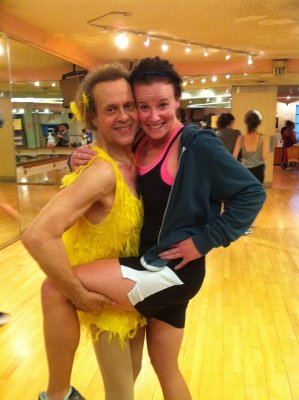
From my second visit to a Richard Simmons class in 2012.


 Dr. Cassidy Hall, DMin, MDiv, MTS, MA
Leave a reply to Michael Moore Cancel reply